
Class 4 Shingles in Texas: Cost, Insurance Discounts, Value
September 21st, 2026
7 min read
Class 4 impact-resistant shingles are asphalt shingles that passed the toughest level of the UL 2218 hail test, and for most Central Texas homeowners they are worth the modest extra cost. They hold up better against the hail that hits Round Rock, Austin, Georgetown, Pflugerville and Hutto every spring, many Texas insurers offer a premium discount for them, and on a typical architectural shingle roof the upgrade adds only a modest amount per square over standard shingles. They do not make a roof hail-proof, and they do not change how your insurance policy treats cosmetic damage, so it pays to understand exactly what you are buying before you sign a contract.
What Class 4 shingles actually are
The "Class" in Class 4 comes from UL 2218, a laboratory test that rates roofing materials for impact resistance. The test drops a steel ball onto a shingle sample from a set height, then inspects the shingle for cracks or splits in the mat and surface. Ratings run from Class 1 to Class 4 based on the size of the ball and the drop height the shingle survives:
- Class 1: withstands the smallest steel ball in the test. Little practical value in hail country.
- Class 2: withstands a mid-sized ball. Roughly the level of many standard shingles.
- Class 3: withstands a larger ball dropped from a greater height. A meaningful step up.
- Class 4: withstands the largest steel ball in the test, dropped from the greatest height, with no cracking on the back of the shingle. This is the highest impact rating available for asphalt shingles.
To earn the rating, a shingle has to survive repeat strikes at the same spot without the reinforcement mat splitting. Manufacturers get there with a more flexible, polymer-modified asphalt blend or a stronger mat, so the shingle absorbs a hit that would bruise or crack a standard product.
Two things the rating does not cover: it does not test for wind uplift (that is a separate standard), and it does not test for granule loss, which is the most common cosmetic complaint after a Texas hail storm. Keep that distinction in mind when we get to the insurance section.
Class 3 vs Class 4 shingles: is the gap real?
Yes. Class 3 shingles survive a smaller steel ball than Class 4, and the drop height is lower. Hail in Central Texas regularly reaches sizes that will bruise a Class 3 shingle while leaving a Class 4 shingle intact. The price difference between Class 3 and Class 4 products from the same manufacturer is usually small, and most of the insurance discounts offered in Texas are tied specifically to a Class 4 rating, not Class 3. If you are already paying extra for impact resistance, Class 4 is almost always the smarter buy.
Where Class 3 can make sense: a rental or a home you plan to sell soon, where the shingle line you want is only offered at Class 3 and you are not counting on an insurance credit. Even then, ask your roofer to price both.
Why impact rating matters more in Central Texas than almost anywhere
Central Texas sits in one of the most active hail corridors in the country. Our hail season runs roughly March through June, with a second round of fall storms. The corridor along IH-35 and SH-130 gets hit often enough that many neighborhoods built in the 2000s are already on their second roof. You can see the pattern for yourself on our Central Texas hail history page.
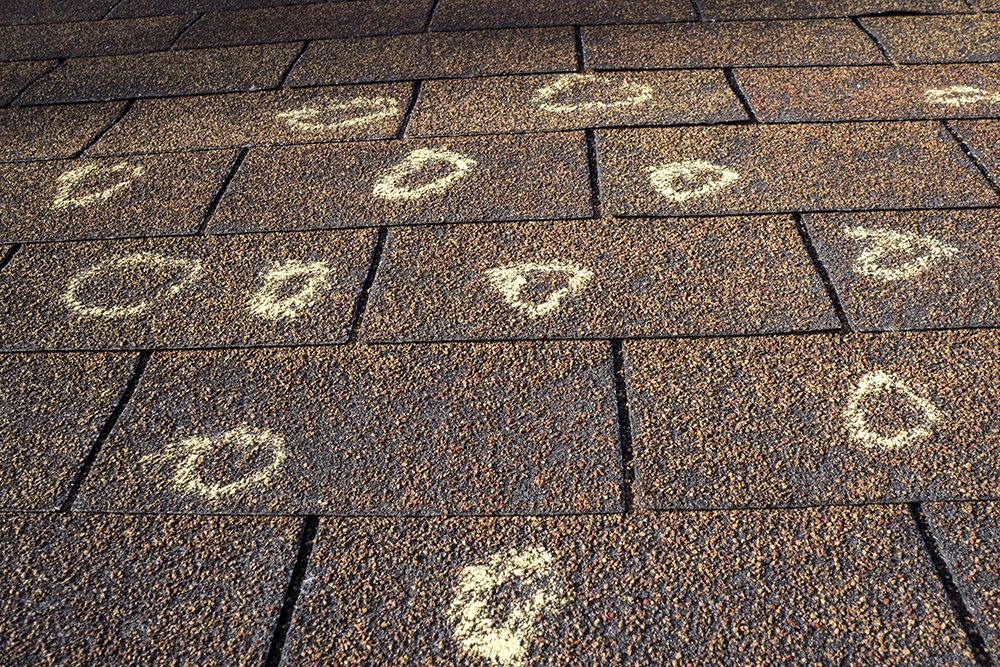
Most homes here have standard architectural asphalt shingles. On those, a hail strike knocks granules loose, bruises the mat, and opens a path for water and UV to break the shingle down over the next several summers. That is why a roof can look fine after a storm and still fail three years early. Our guide to roof hail damage walks through what that damage looks like up close.
A Class 4 shingle changes the math. It flexes and recovers from most strikes, which means fewer claims, fewer deductibles paid, and a better chance your roof reaches the 20 to 30 years architectural asphalt typically lasts in Texas heat.
Insurance discounts for Class 4 roofs in Texas
Many Texas insurers offer a premium discount for homes with a UL 2218 Class 4 roof. The size of the discount varies by carrier, by policy, and sometimes by county, so we do not quote a percentage. What we can tell you is how to make sure you get whatever your carrier offers:
- Ask your carrier before you sign the roofing contract. Confirm they offer a Class 4 credit, what documentation they need, and whether the shingle line you are considering qualifies.
- Get the product certification in writing. Your roofer should give you the manufacturer's Class 4 certification for the exact shingle installed, plus an invoice that names the product. KangaRoof provides both on every Class 4 install.
- Some carriers require a signed form. Texas insurers often use a roof certification form that the contractor completes. Ask for it up front.
- Review your policy for a cosmetic damage exclusion. More on this below. It matters.
If you are replacing a roof through an insurance claim right now, the Class 4 upgrade is usually paid by you, not the carrier, since the policy covers replacing what you had. The good news is the upgrade cost is small, and the discount continues every year afterward. Our insurance process page explains how a claim moves from inspection to final payment, and where an upgrade fits in.
How much more do Class 4 shingles cost?
Modestly more per square than a standard architectural shingle from the same manufacturer. A square is 100 square feet of roof, and per our Instant Roof Cost Calculator, asphalt shingle systems in our area start around $350 per square installed for the base tier and run to about $618 per square for the top tier. Class 4 products sit in the middle and upper tiers of that range. On a typical 30-square Round Rock home, the difference between a standard architectural shingle and a Class 4 shingle is a fraction of the total roof price, and on most policies the annual insurance credit repays that difference within a few years.
Steep pitch, two stories, extra tear-off layers and bad decking move the number more than the shingle grade does. Run the calculator with your square footage for a starting number, then let us confirm it in person. KangaRoof quotes guaranteed pricing: the number on the quote is the number on the invoice, not an estimate that grows after the crew is on the roof.
Do Class 4 shingles prevent all hail damage?
No, and any roofer who says otherwise is overselling.
Functional damage vs cosmetic damage
Functional damage means the shingle can no longer do its job: the mat is cracked, the seal is broken, or the shingle is punctured and water can get through. Cosmetic damage means the surface is marked, granules are knocked loose, or there are dents that do not affect water shedding. Class 4 shingles are far more resistant to functional damage. They still lose granules in a heavy storm, and very large hail or hail driven by strong wind can damage anything.
The cosmetic exclusion
Because Class 4 roofs earn a discount, some Texas insurers pair that discount with a cosmetic damage exclusion. Under that endorsement, the carrier pays for hail damage that affects the roof's function but not for damage that is only cosmetic. The same exclusion is common on metal roofs. It is not a reason to avoid Class 4, but read the endorsement and ask your agent what "cosmetic" means under your policy. For most homeowners the tradeoff is worth it, because functional damage is what causes leaks and replacement, and that stays covered.
Wind and heat are still in play
The impact rating says nothing about wind uplift or the 100 degree summers that cook Central Texas roofs. Correct nailing, attic ventilation and a quality underlayment matter as much as the shingle grade.
Installation and warranty: why the crew matters as much as the shingle
A Class 4 shingle installed badly is still a bad roof. KangaRoof is a GAF Master Elite contractor, a certification GAF extends to a small share of roofers, and it lets us offer GAF's enhanced warranties on qualifying systems. Those warranties cover materials and workmanship, provided the installation followed the manufacturer's specifications for nailing, starter and ridge products, underlayment and ventilation.
GAF offers Class 4 lines in its architectural shingle families, and we install them across Round Rock, Austin and the surrounding Central Texas cities. See our asphalt shingle roofing page for the systems we carry and how the tiers compare. For the full replacement process, from tear-off to final walkthrough, see roof replacement.
Class 4 decision checklist
Run through this before you commit:
- Is your roof at or near end of life? Architectural asphalt typically lasts 20 to 30 years in Texas, often less. If you are replacing anyway, the upgrade cost is smallest now.
- Has your neighborhood been hit more than once? Teravista, Forest Creek, Paloma Lake, Falcon Pointe, Star Ranch, Sun City and the SH-130 corridor all have repeat hail history. Repeat hail means repeat deductibles without Class 4.
- Does your carrier offer a Class 4 discount? Call and ask. Get the answer in writing.
- Does the discount come with a cosmetic exclusion? Read it. Decide with your eyes open.
- Is the roofer certified to install the product? Manufacturer warranties depend on it.
- Do you plan to stay five years or more? That is the window where the insurance savings and the avoided deductibles add up.
- Is your quote guaranteed? An estimate that can change is not a price.
If you check most of those boxes, Class 4 is the right call.
FAQ
Are Class 4 shingles worth it in Texas?
For most Central Texas homeowners, yes. Hail hits the Round Rock and Austin area every spring, Class 4 shingles resist functional hail damage far better than standard shingles, the cost premium is modest per square, and many Texas insurers offer an annual premium discount. Over a five to ten year stretch the savings and avoided deductibles usually exceed the upgrade cost.
What is the difference between Class 3 and Class 4 shingles?
Both are rated under UL 2218, but Class 4 survives a larger steel ball dropped from a greater height without cracking. Class 4 is the highest impact rating for asphalt shingles, and most Texas insurance discounts are tied to Class 4 specifically, not Class 3.
How much do Class 4 shingles cost compared to regular shingles?
Modestly more per square. Per our roof cost calculator, asphalt shingle systems in Central Texas start around $350 per square installed and run to about $618 per square at the top tier, and Class 4 products fall in the middle and upper part of that range. Pitch, stories, and decking condition affect the total more than the shingle grade does.
Will my insurance company give me a discount for a Class 4 roof?
Many Texas insurers do, but the amount and requirements vary by carrier. Ask your agent before you sign a roofing contract, get the manufacturer's Class 4 certification and the roofer's invoice naming the product, and check whether the discount comes with a cosmetic damage exclusion.
Does GAF make Class 4 shingles?
Yes. GAF offers Class 4 impact-resistant options within its architectural shingle lines, and as a GAF Master Elite contractor KangaRoof installs them with GAF's enhanced warranty coverage available on qualifying systems.
Not sure whether your roof needs a repair, a replacement, or a Class 4 upgrade before the next hail season? Call KangaRoof at (512) 388-7663 for a free roof inspection with photos and a written summary, and a guaranteed price if any work is needed.
Related reading
Written and published by KangaRoof, the Round Rock roofing company founded as Feller Roofing in 1992.

.jpg?width=1280&height=667&name=Why%20Is%20My%20Deductible%20So%20High%20thumb%20(1).jpg)