
How Long Does a Roof Last in Texas? Shingle, Metal, Tile
September 21st, 2026
7 min read
In Central Texas, an asphalt shingle roof typically lasts 15 to 20 years for 3-tab shingles and 20 to 30 years for architectural shingles, and many roofs in Round Rock, Austin and the surrounding suburbs come in at the low end of those ranges or below them. Metal roofs typically last 40 to 60 years, and tile roofs 50 years or more. Those are general industry ranges, not promises, and the reason Texas roofs so often fall short is the climate: months of 100F days, brutal UV, attic temperatures that bake shingles from underneath, and hail seasons that arrive every spring. This guide walks through how long each roofing material lasts here, why our weather shortens that number, how to tell when your roof is near the end, and what you can do to buy it more time.
Why roofs wear out faster in Central Texas
A shingle roof in a mild climate can coast toward the top of its rated life. A shingle roof in Williamson County or Travis County is working hard from the first summer. Four things do most of the damage.
- UV exposure. Asphalt shingles are held together by oils and a fiberglass mat, and sunlight slowly cooks the oils out. As the asphalt dries, shingles get brittle, curl at the edges, and shed the protective granules that reflect sunlight. Central Texas gets a lot of clear, high-sun days, so this process runs faster than it does up north.
- Attic heat. On a 100F afternoon, an under-ventilated attic can run far hotter than the air outside. That heat sits directly under the decking and cooks the shingles from below at the same time the sun cooks them from above. Roofs on poorly vented houses age noticeably faster than roofs on the same street with good airflow.
- Hail. Central Texas hail season runs roughly March through June, with fall storms on top of that. Even hail that does not cause a covered insurance claim can knock granules loose and bruise the mat, and every bruise is a spot that will fail years before the shingles around it.
- Thermal cycling. Shingles expand in the afternoon heat and contract overnight, every day, for decades. That constant movement works nails loose, opens seams in flashing, cracks sealant around pipe boots, and fatigues the shingle itself. Add a few sudden cold fronts in winter and the swings get even bigger.
Wind is the fifth factor. Storm gusts lift shingle tabs, break the adhesive seal, and let water and more wind get underneath.
Roof lifespan by material in Texas
The material you have on your house sets the ceiling. The climate and the installation decide how close you get to it.
3-tab asphalt shingles: 15 to 20 years
3-tab shingles are the thinnest, lightest and least expensive asphalt option. They were common on production homes built through the 1990s and early 2000s, so some older Round Rock and Pflugerville houses still have them. In Texas heat, a 3-tab roof often shows real wear well before its 15th birthday: flat, faded tabs, exposed mat, and granules piling up at the downspouts. If your home still has its original 3-tab roof from the 1990s, it is almost certainly at or past the end of its useful life.
Architectural asphalt shingles: 20 to 30 years, often less in Texas heat
Architectural (also called dimensional or laminated) shingles are what most Round Rock homes have today. They are thicker, heavier and carry longer manufacturer warranties, and they hold up better in wind. The typical range is 20 to 30 years, but on a Central Texas roof with average ventilation, 20 years is a good outcome and many roofs need replacing sooner. The heat and hail simply take more out of them than the ratings assume. Class 4 impact-resistant shingles (UL 2218 Class 4 rating) resist hail bruising better and many insurers offer a premium discount for them, which is worth asking your carrier about.
Metal roofing: 40 to 60 years
Standing seam and metal shingle roofs are the long-haul option for Texas. Metal does not dry out or shed granules, it typically reflects heat instead of absorbing it, and it sheds hail far better than asphalt. The trade-off is cost: per our calculator, metal runs about $1,150 to $1,470 per square installed, compared with roughly $350 to $618 per square for asphalt shingle systems. The math often favors metal for homeowners who plan to stay long term or who live in windy Hill Country areas like Dripping Springs, where metal roofs are already common.
Tile roofing: 50 years or more
Concrete and clay tile roofs are common in parts of Georgetown, including Sun City, and on some higher-end homes around Austin. The tiles themselves typically last 50 years or more. What usually fails first is the underlayment beneath them and the flashing around penetrations. A leaking tile roof usually needs new underlayment, not new tile.
Signs your roof is near the end
Age alone does not tell you when to replace. Condition does. From the ground, these are the signals that a roof is running out of time.
- Shingles that are curling at the edges, cupping in the middle, or cracking.
- Bald spots where granules have worn off and the dark mat shows through.
- Granules collecting in gutters, at the bottom of downspouts, or on the driveway after rain.
- Missing or torn shingles after a windy day, or tabs that lift when the wind blows.
- Sagging along the ridge or between rafters, which points to decking or structural problems.
- Moss, algae streaks, or debris that stays damp between rains.
- Water stains on ceilings, rust on flashing, or daylight visible through the attic decking.
- Neighbors with same-age homes replacing their roofs after a hail season.
We cover the visual clues in more detail in 7 Signs You Need a New Roof, and the more serious structural red flags in 10 Serious Warning Signs Your Roof Isn't Safe. If you are seeing anything on the second list, do not wait for the next storm.
Ventilation: the factor most homeowners never check
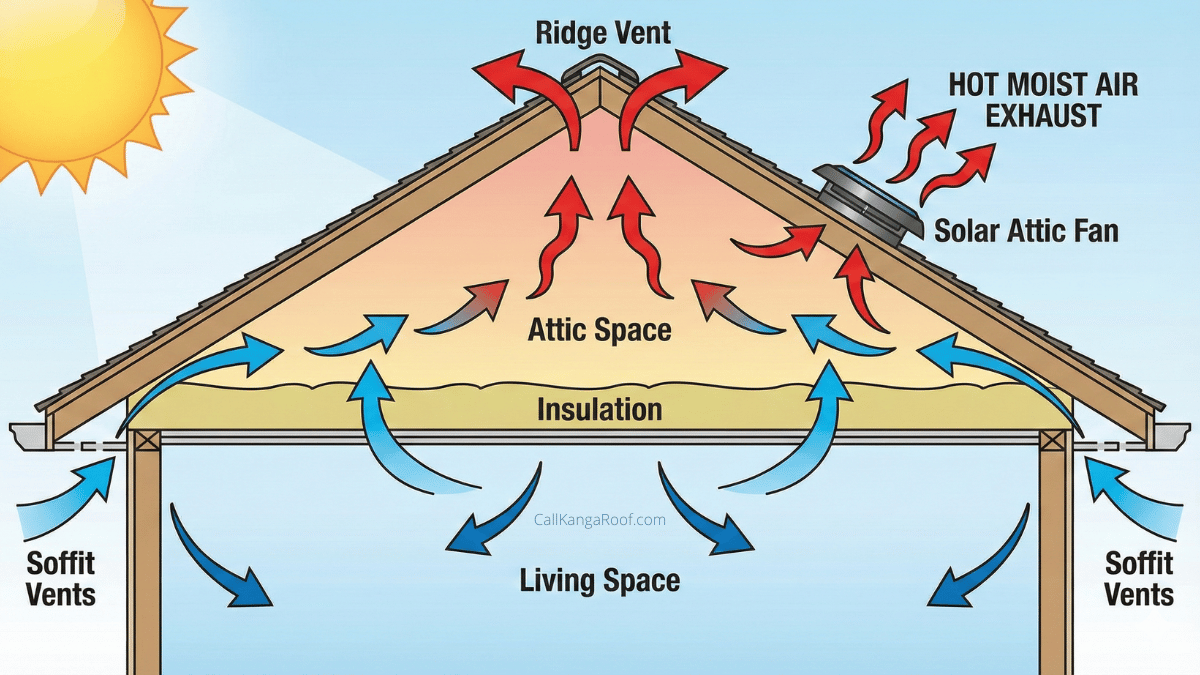
If two identical houses in Teravista get identical roofs on the same day, the one with proper attic ventilation will outlast the other. Intake vents at the soffit pull cooler air in, exhaust vents at or near the ridge let hot air out, and the constant flow keeps the underside of the decking closer to outdoor temperature. Without that flow, summer heat builds up under the roof, shingles cook from below, and moisture from bathrooms and kitchens condenses on the decking in winter. Both shorten roof life, and both can void a manufacturer warranty if ventilation requirements were not met.
Many 1990s and 2000s subdivisions got the minimum vents required at the time, and insulation added later sometimes blocks the soffit intakes entirely. You can read how the system is supposed to work in How Roof Ventilation Works. Fixing ventilation is inexpensive compared with replacing a roof five years early.
Maintenance that extends a Texas roof's life
You cannot change the weather, but you can keep small problems from becoming the reason your roof fails early. The maintenance that matters most here:
- Clean gutters and downspouts before spring storm season and again after the trees drop. Backed-up gutters push water under the shingle edge and rot the fascia.
- Trim branches that hang over the roof. They drop debris, hold moisture, and scrape granules off in the wind.
- Reseal or replace cracked pipe boots and worn sealant around vents and flashing. These small rubber and caulk details fail long before the shingles do and cause most of the leaks we see.
- Replace individual damaged shingles promptly instead of leaving a gap that lets wind lift the neighbors.
- Get the roof looked at after any hailstorm, even if nothing looks wrong from the driveway.
- Have a professional inspection every year or two, and always after a major storm.
For homeowners who would rather not track all of this, KangaRoof's Overhead Care Club is a roof and gutter maintenance membership that handles the routine care and keeps a record of the roof's condition over time. That record is useful when an insurance adjuster asks what shape the roof was in before a storm.
When to replace before the roof fails
The cheapest roof replacement is the one you schedule on your own terms. A roof that fails during a storm brings interior damage, emergency tarping and a rushed decision, and none of it is covered if the cause was age rather than the storm. A few guidelines for timing it well:
- If an architectural shingle roof is 18 to 20 years old and showing widespread granule loss, start planning now rather than after the next leak.
- If repairs are getting more frequent and the roof is past 15 years, the money is usually better spent on replacement.
- If you are selling in the next few years, a new roof with a transferable warranty is a real selling point, and an old roof is a negotiating point for the buyer's inspector.
- If an inspection confirms storm damage, a replacement through an insurance claim may cost you only your deductible.
Replacing a roof is not a small purchase, so budget for it early. The Instant Roof Cost Calculator gives a real number for your home, and every KangaRoof quote is a guaranteed price: the quoted price is the price, not an estimate. Details on materials, process and what to expect on install day are on our roof replacement page.
FAQ
How long does a shingle roof last in Texas?
Typically 15 to 20 years for 3-tab shingles and 20 to 30 years for architectural shingles, with many Central Texas roofs landing at or below the low end because of heat, UV and hail. Good ventilation and regular maintenance push a roof toward the higher number.
How long does a metal roof last in Texas?
Metal roofs typically last 40 to 60 years. They do not shed granules or dry out the way asphalt does, they typically reflect heat rather than absorbing it, and they hold up well to hail and wind, which is why they are common in the Hill Country.
Does Texas heat really shorten roof life?
Yes. UV dries the oils out of asphalt shingles, attic temperatures far above 100F bake them from underneath, and daily expansion and contraction fatigues the shingles and loosens fasteners. A roof rated for 30 years in a mild climate often needs replacing closer to 20 here.
Can I extend my roof's life without replacing it?
Often, yes. Fixing attic ventilation, keeping gutters clear, replacing worn pipe boots and sealant, and repairing storm damage promptly all add years. What maintenance cannot fix is widespread granule loss or brittle, cracking shingles; at that point the material itself is done.
How do I know if my roof needs replacing now or can wait?
A free inspection is the reliable answer. It checks shingles, flashing, ventilation and decking together and tells you whether you are looking at a repair, a planned replacement in a year or two, or a roof that should not see another hail season.
If you are wondering how many years your roof has left, call KangaRoof at (512) 388-7663 and we will come out for a free inspection with photos and a written summary of exactly where it stands.
Related reading
Written and published by KangaRoof, the Round Rock roofing company founded as Feller Roofing in 1992.
Topics: